
If you’ve been publishing content and doing everything right on-page, but your rankings still aren’t moving, backlinks are almost always the missing piece. A backlink — another website linking to yours — is one of the strongest trust signals in SEO, and in 2026 it does double duty: it still drives rankings, and it increasingly shapes whether AI models like ChatGPT and Gemini recognize your brand as a credible source to cite. Here’s a realistic, beginner-friendly plan for earning your first backlinks without a big budget or an outreach team.
Why Backlinks Still Matter This Much
When another website links to yours, search engines treat it as a vote of confidence — a signal that real people find your content useful enough to reference. Google continues to rank backlinks among its top ranking factors, and that isn’t expected to change soon.
What has changed is the second layer: backlinks now also shape how AI models understand your brand. When relevant, credible sites link to you and mention you alongside specific topics, large language models start associating your name with those topics — which affects whether you get cited in an AI-generated answer, not just whether you rank on a search results page. A strong backlink profile is now working for you in both directions.
Start With the Easiest Wins First
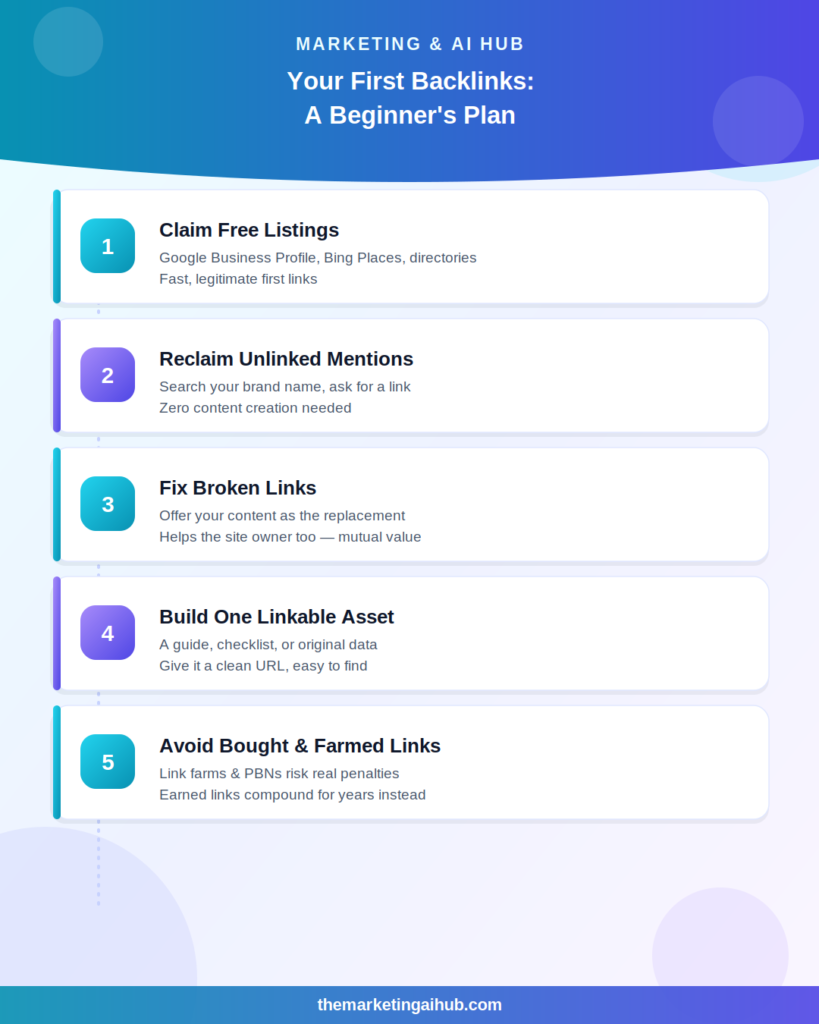
1. Claim your free directory and social listings. Before chasing outside sites, make sure your business is listed on Google Business Profile, Bing Places, and relevant free directories in your niche. These are quick to set up and give you your first handful of legitimate links pointing back to your site.
2. Reclaim unlinked mentions. If anyone has mentioned your name or brand online without linking to you, that’s the easiest backlink you’ll ever get — just reach out and politely ask them to add a link. This requires zero content creation, just a quick search of your brand name and a short email.
3. Fix broken links on other sites (broken link building). Find a page on a relevant website with a dead or outdated link, and offer your own content as the replacement. You’re helping the site owner fix a real problem while earning a link — it’s one of the few link-building tactics that benefits both sides genuinely.
Build a Few “Linkable Assets”
You don’t need dozens of backlinks — a handful of genuinely good ones from relevant sites will outperform a large volume of weak ones. The content most likely to earn links naturally:
- Original guides or how-tos that are more thorough or more current than what already exists on a topic
- Original data or a small survey — even a simple poll of 20-30 people in your niche can become something other writers cite
- A tool, checklist, or template people bookmark and reference repeatedly
Give these a clean, dedicated URL and make them easy to find in your site’s navigation — a great resource buried three clicks deep is much harder for people to link to.
Guest Posting, Done Properly
Guest posting still works, but the version that gets penalized is dropping a keyword-stuffed link into any site that accepts submissions. The version that actually helps: pitching a genuinely useful, specific article to a site that covers your niche, with a natural, relevant link back to your content — not your homepage, but the specific page that supports what you wrote.
What to Avoid Completely
- Buying links or joining link exchange schemes — these violate search engine guidelines and can trigger ranking penalties
- Link farms or automated submission tools promising “500 backlinks for $20” — these are recognized patterns that search engines actively discount or penalize
- Excessive reciprocal link swapping — an occasional link between genuinely related sites is fine, but building a strategy around swapping links at scale is risky
Track What You’re Building
Use Google Search Console (which you likely already have connected) to monitor which sites are linking to you over time, and watch for anything spammy or low-quality that could be worth disavowing later. You don’t need a paid tool to get started — Search Console alone gives you a real picture of your backlink profile as it grows.
A Realistic First 30 Days
- Week 1: Claim your directory listings and reclaim any unlinked brand mentions
- Week 2: Identify 5–10 broken link opportunities in your niche and send outreach emails
- Week 3–4: Publish one strong linkable asset (a comprehensive guide or original checklist) and share it directly with a few relevant sites or communities
Backlinks compound — the effort you put in during your first month keeps paying off for years, unlike a paid ad that stops the moment you stop spending. Start with the easy wins, and build outward from there.
Want help identifying realistic backlink opportunities for your specific niche, or auditing your current backlink profile? Visit
themarketingaihub.com/contact