
Every piece of SEO advice eventually comes back to one starting point: knowing what your audience is actually searching for. Keyword research is that foundation — skip it, and even great content ends up targeting the wrong terms, competing in the wrong space, or missing search intent entirely. This guide covers what keyword research actually is, how to do it step by step, and how it’s evolving now that AI search sits alongside traditional Google results.
What Is Keyword Research?
Keyword research is the process of finding and analyzing the actual words and how to do keyword research phrases people type into search engines when looking for something related to your business, content, or niche. The goal isn’t just finding words with high search volume — it’s finding the specific terms your real audience uses, understanding what they actually want when they search that term, and figuring out which of those terms you have a realistic chance of ranking for.
Done well, keyword research shapes everything downstream: what you write about, how you title it, what questions you answer, and even what products or services you emphasize.
Why It Matters More Than People Think
Writing content without keyword research is like opening a shop without checking whether anyone walks down that street. You might write a genuinely excellent article — but if nobody searches for the phrase you built it around, or if the phrase is dominated by huge, unbeatable competitors, that effort won’t translate into traffic. Keyword research is what connects the content you’re capable of creating with the demand that actually exists.
The Three Things Every Keyword Has
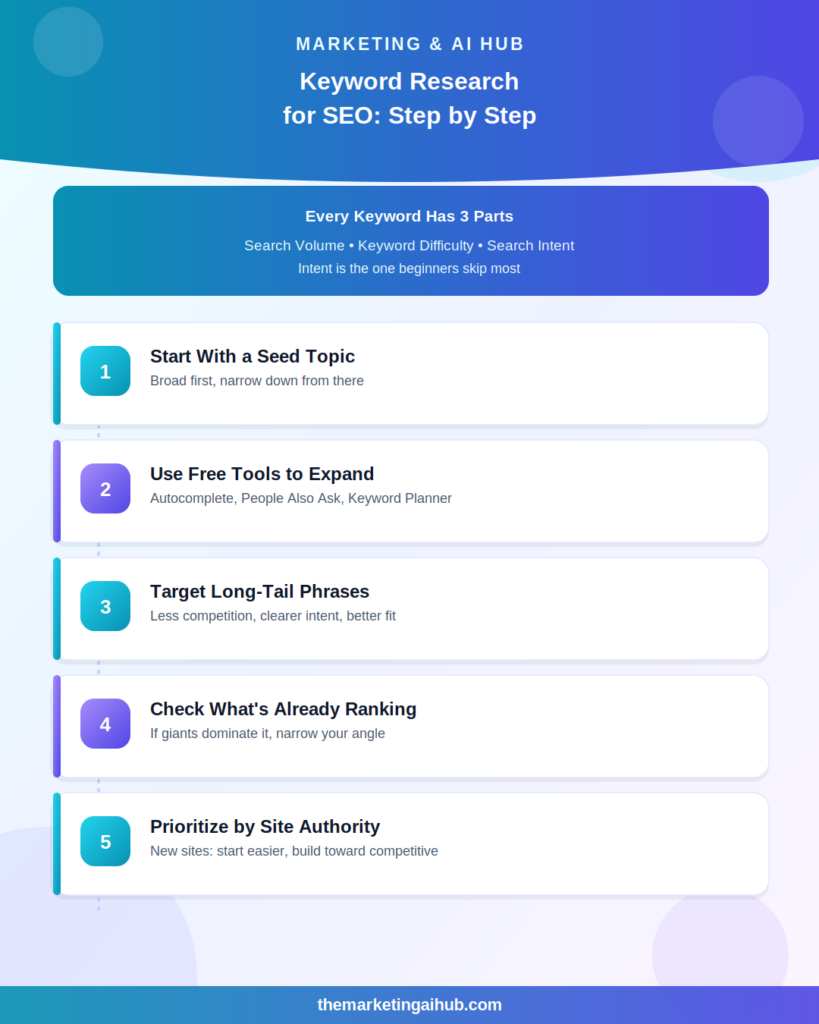
1. Search volume — roughly how many people search that term per month. Higher volume means more potential traffic, but usually more competition too.
2. Keyword difficulty — how hard it is to rank for that term, based on how strong the sites currently ranking for it are. A new website has little chance of outranking established authority sites for highly competitive terms right away.
3. Search intent — what the person actually wants when they type that search. This is the piece beginners skip most often, and it’s arguably the most important. Someone searching “what is Google Search Console” wants an explanation. Someone searching “Google Search Console pricing” wants to know if it costs money. Someone searching “Google Search Console not showing data” wants troubleshooting help. Same general topic, three completely different intents — and content that matches the wrong intent won’t rank, no matter how well it’s written.
How to Actually Do Keyword Research, Step by Step
1. Start with a seed topic. Begin broad — something like “Google Ads” or “freelance marketing” — this is your starting point, not your final keyword.
2. Use free tools to expand it. Google’s own “Search Console Performance” report (if your site is established), the autocomplete suggestions in Google’s search bar, and the “People also ask” and “Related searches” sections on a results page are all free and reveal real phrases people actually search. Google Keyword Planner (inside Google Ads) also gives volume estimates for free with a linked account.
3. Look for long-tail variations. Short, broad terms (“SEO,” “Google Ads”) are extremely competitive and vague in intent. Longer, more specific phrases (“how to lower Google Ads CPC for small business”) have lower volume individually, but much clearer intent, less competition, and often convert better because the searcher is further along in deciding what they need.
4. Check what’s actually ranking. Search your candidate keyword yourself and look at what’s currently on page one. If it’s dominated by massive, established sites for a broad term, that’s a signal to narrow your angle rather than compete head-on.
5. Group keywords by intent, not just topic. Cluster keywords that share the same underlying intent together — this helps you figure out whether one comprehensive page can cover several related searches, or whether you need separate pages for genuinely different intents.
6. Prioritize based on your site’s current authority. A brand-new site should generally start with lower-competition, longer-tail keywords where ranking is realistic, and build toward more competitive terms as the site earns trust and backlinks over time.
Keyword Research in the Age of AI Search
Keyword research hasn’t become irrelevant with the rise of AI Overviews and AI chat assistants — but it has expanded. AI models answering a question still draw from real content written around real search terms, so the fundamentals haven’t changed. What has changed is that it’s worth also thinking in terms of the actual questions people would type into ChatGPT or Gemini, not just Google’s search bar — often longer, more conversational phrasing than classic keyword research assumed. Writing content that directly and clearly answers a specific question remains valuable in both search environments at once.
Common Beginner Mistakes to Avoid
- Chasing high-volume keywords with no realistic chance of ranking. A new site competing directly against major established brands for a broad, high-volume term is very unlikely to succeed for a long time.
- Ignoring search intent entirely. Ranking for a keyword doesn’t matter if your content doesn’t match what the searcher actually wanted.
- Treating keyword research as a one-time task. Search behavior shifts over time — revisiting your keyword strategy periodically keeps content aligned with what people are actually searching for now, not what they searched a year ago.
- Keyword stuffing. Once you have a target keyword, use it naturally — forcing it repeatedly into text reads poorly and doesn’t help rankings the way it once did.
The Bottom Line
Keyword research is the step that makes every other SEO effort actually count. It’s not about chasing the highest-volume term you can find — it’s about understanding exactly what your specific audience is searching for, matching their intent precisely, and choosing battles your site can realistically win at its current stage. Get this step right, and everything built on top of it — content, backlinks, on-page SEO — has something solid to stand on.
Want help identifying the right keywords for your specific niche and current site authority? Get in touch.