
If you’ve just launched a website and Google Search Console is showing “Processing data, please check again in a
day or so,” that’s normal — but there’s a lot you can do to speed the process up rather than just waiting. Here’s a
practical checklist for getting a brand-new site indexed and appearing in search results faster.
Why New Sites Take Time to Get Indexed
Google doesn’t discover and rank new websites instantly. A new domain has no history, no backlinks, and no
established trust signals, so Google’s crawlers need to find your pages, evaluate them, and decide they’re worth
indexing. For a brand-new site, this process commonly takes anywhere from a few days to several weeks — even
when everything is set up correctly.
The good news: you’re not powerless during that window. A handful of actions can meaningfully speed things up.
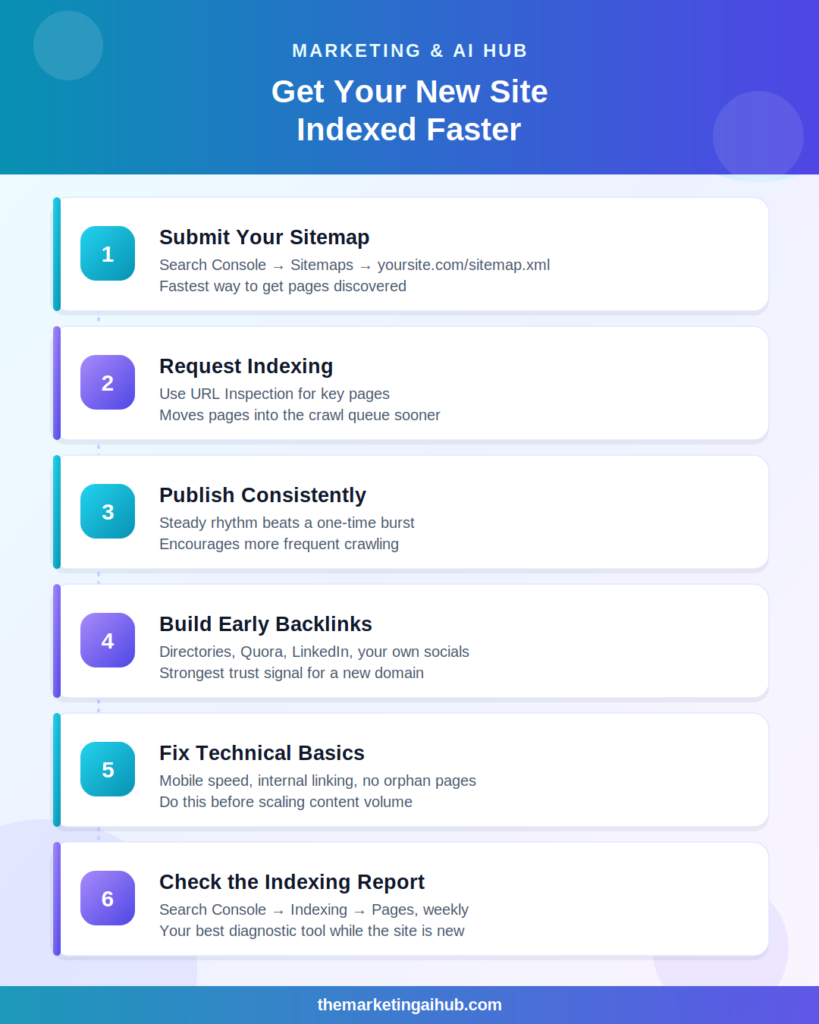
- Submit a Sitemap in Search Console
Your sitemap is a file that lists every page on your site, and submitting it tells Google exactly what to crawl
instead of waiting for it to discover pages on its own.
In Search Console, go to Sitemaps in the left sidebar and submit your sitemap URL (usually
yoursite.com/sitemap.xml — most SEO plugins like Yoast or RankMath generate this automatically). This is the
single fastest action you can take to speed up discovery. - Request Indexing for Individual Pages
For your most important pages (homepage, key blog posts, service pages), use the URL Inspection tool in
Search Console. Paste the page URL into the inspection bar, and if it says “URL is not on Google,” click Request
Indexing. This won’t guarantee instant indexing, but it does move eligible pages into the crawl queue faster. - Publish Consistently, Not in One Burst
Google tends to trust sites that show an ongoing pattern of activity over sites that publish a handful of pages and
go quiet. A steady rhythm — even one post a week — signals that the site is active and worth revisiting, which
encourages more frequent crawling over time. - Build a Few Early Backlinks
Backlinks remain one of the strongest trust signals for a new domain. You don’t need many to start: list your
business in relevant directories, share your content where it’s genuinely useful (relevant subreddits, Quora
answers, LinkedIn posts that link back), and link to your website from your existing Facebook or YouTube profiles. - Fix Technical Basics Before Scaling Content
Before publishing dozens of posts, make sure the foundation is solid: mobile page speed (slow-loading pages get
crawled less frequently), internal linking (link your new blog posts to each other and to your service pages), and
no orphan pages (every page should be reachable through at least one link). - Check the Indexing Report Regularly
Once Search Console finishes processing (usually within 24–48 hours of setup), the Indexing → Pages report will
show exactly which pages are indexed and which are excluded, along with the reason for any exclusions. This
report is your best diagnostic tool — check it weekly while your site is new.
The Realistic Timeline
For a new domain doing everything right, expect first indexed pages within days to 1–2 weeks after sitemap
submission, first organic search impressions within the first few weeks, and meaningful organic traffic typically in
3–6 months, depending on competition for your target keywords and how consistently you publish.
Patience matters here, but so does action — the sites that get indexed and start ranking fastest are the ones
actively submitting sitemaps, requesting indexing on key pages, and publishing on a steady schedule, not the
ones that set everything up once and wait.
Want help auditing your site’s technical SEO setup or building a content calendar that keeps Google crawling regularly? Visit
themarketingaihub.com/contact