
Google Ads just moved through one of its biggest shifts in years, and if you manage campaigns for clients or your
own business, there are three changes worth understanding right now: AI Max is officially out of beta, the
Dynamic Search Ads migration timeline just changed, and Google’s Terms of Service were rewritten for the first
time since 2018. Here’s what actually matters and what to do about it.
AI Max for Search Is Now Generally Available
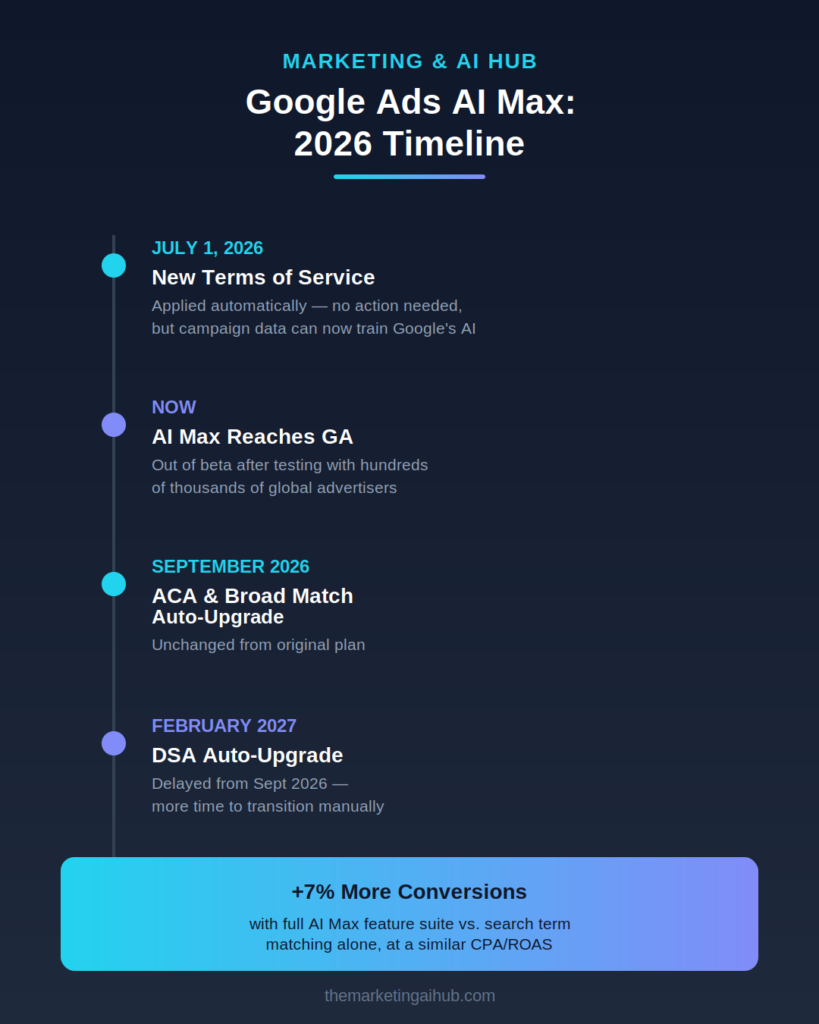
AI Max — Google’s AI-powered evolution of Search campaigns — has moved out of beta after testing with
hundreds of thousands of advertisers globally. It combines your existing ads and website content with broader
real-time intent signals to surface search queries you’d otherwise miss, while giving you more advanced brand,
location, and text controls than the older Dynamic Search Ads setup offered.
In Google’s own testing, campaigns using the full AI Max feature suite (search term matching, text customization,
and final URL expansion) saw meaningfully higher conversions or conversion value at a similar cost-per
acquisition, compared to using search term matching alone.
The DSA-to-AI-Max Timeline Just Shifted
This is the part advertisers need to track closely, because the dates are not what was originally announced:
Dynamic Search Ads (DSA) auto-upgrade to AI Max was originally set for September 2026 — Google has now
pushed this specifically to February 2027, giving advertisers more runway to transition manually.
Automatically Created Assets (ACA) and campaign-level broad match settings are still auto-upgrading in
September 2026, unchanged from the original plan.
If you’re managing an account that still runs on legacy DSA, this delay buys you time to test AI Max on your own
terms rather than being force-migrated. But don’t assume everything got pushed back — the ACA and broad
match auto-upgrades are still on the original September clock.
Google’s Terms of Service Changed on July 1, 2026
Alongside the product changes, Google rewrote its Google Ads Terms of Service for the first time in eight years,
effective July 1, 2026. No action was required from advertisers — the new terms applied automatically to every
account. A few points worth knowing:
Your campaign data can train Google’s AI. Inputs you provide while setting up campaigns — including
conversations with Gemini or AI Max setup flows — can now be used to improve Google’s systems more broadly,
not just your own account.
Crawling permissions are now explicit. Connecting a Merchant Center feed or turning on Performance Max/AI
Max now comes with an explicit contractual right for Google to crawl and index your site content to generate ad
assets.
Liability sits more clearly with the advertiser. With AI generating a growing share of ad assets and copy
automatically, the updated terms make clearer that the advertiser, not Google, is responsible for reviewing and
approving what goes live.
What To Actually Do This Month
- Audit what’s auto-generating in your account. If you’re running Performance Max, AI Max, or have
Automatically Created Assets turned on, review what’s currently live — a quarterly check is no longer frequent
enough. - Decide your DSA timeline deliberately. With the extra runway to February 2027, test AI Max in a controlled
way rather than waiting for a forced migration. - Re-check brand and text controls. AI Max’s expanded controls (brand safety, location targeting, text
guidelines) are worth configuring properly now rather than relying on defaults. - Flag sensitive copy before automation touches it. If your ad copy or brand voice involves client work you
don’t want reused to train broader systems, that’s now something to actively manage. - Build a recurring review habit, not a one-time check — auto-generated assets change continuously, and
“set and forget” is no longer a safe approach.
The Bigger Picture
Google Ads is shifting from a keyword-matching platform to an AI-driven ecosystem where advertiser trust,
website quality, and clear brand controls matter as much as budget. Advertisers who actively steer these AI tools
— rather than accepting every default — are the ones who’ll see the conversion gains Google is promising,
without losing control of their brand or budget in the process.
Managing a Google Ads account and unsure how AI Max or the new Terms of Service affect your campaigns? Visit
themarketingaihub.com/contact for an account audit.