
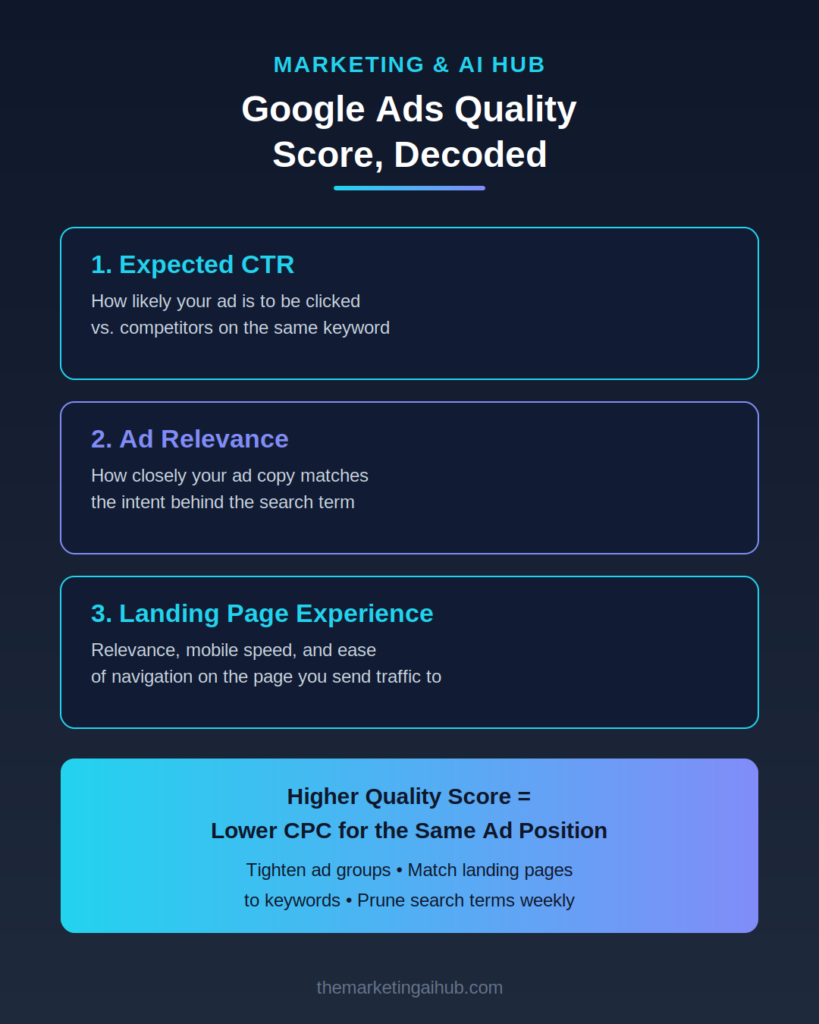
If you’re running Google Ads and your cost-per-click feels too high, the fastest lever to pull usually isn’t your bid —
it’s your Quality Score. A higher Quality Score means Google charges you less to win the same ad position. Here’s
how it actually works and what to fix first.
What Quality Score Actually Is
Quality Score is Google’s 1–10 rating of how relevant your keyword, ad, and landing page are to a searcher’s
query. It’s not a ranking factor you set directly — it’s a diagnostic score built from three components, each rated
“Below Average,” “Average,” or “Above Average.”
The 3 Components
- Expected Click-Through Rate (CTR)
Google predicts how likely your ad is to get clicked when it shows for a given keyword, compared to other
advertisers targeting the same term. Weak expected CTR is usually a sign your keyword and ad copy don’t match
tightly enough, or your ad lacks a compelling reason to click. - Ad Relevance
This measures how closely your ad’s messaging matches the intent behind the keyword. If you’re bidding on
“emergency plumber Dallas” but your headline says “Plumbing Services,” that’s a relevance gap Google can see
and penalize. - Landing Page Experience
Google evaluates whether your landing page is relevant, transparent, and easy to navigate — and increasingly,
how fast it loads on mobile. A landing page that doesn’t mention the keyword anywhere, or that loads slowly,
drags this score down even if your ad copy is excellent.
Why Your Score Might Be Dropping?
Broad ad groups — one ad group targeting 20+ loosely related keywords almost always tanks Ad Relevance,
because one ad can’t speak precisely to that many intents.
Generic landing pages — sending every campaign to your homepage instead of a keyword-matched page.
Ignoring search terms reports — letting irrelevant queries trigger your ads drags down Expected CTR over
time.
Slow mobile load times — Google now weighs Core Web Vitals into Landing Page Experience.
How to Actually Improve It.
1. Tighten ad groups. Aim for 5–10 closely related keywords per ad group (Single Keyword Ad Groups if the
account size allows), so ad copy can mirror the exact search intent.
2.Mirror keyword language in headlines. If someone searches “affordable Google Ads management,” your
headline should say something close to that — not just “Digital Marketing Services.”
3.Build keyword-matched landing pages. Even a simple, fast-loading page that clearly answers the search
intent outperforms a generic homepage.
4.Prune search terms weekly. Add negative keywords for irrelevant queries before they drag down your
average CTR.
5.Check mobile page speed. Use PageSpeed Insights and fix anything scoring below 50 on mobile — this is a
frequently ignored piece of Landing Page Experience.
The Payoff
Moving a keyword from a Quality Score of 5 to 8 can meaningfully lower what you pay per click for the same ad
position, since Google’s ad rank formula directly factors Quality Score against your bid. For accounts spending
serious budget monthly, that difference compounds fast.
Managing Google Ads and want a second set of eyes on your account’s Quality Score issues?
Visit-themarketingaihub.com/contact