
If you’ve read anything about building backlinks or growing website traffic, you’ve probably run into the term “guest posting.” It’s one of the oldest tactics in SEO, and it still works in 2026 — but only when it’s done properly. This guide covers exactly what guest posting is, how it works, and how to do it in a way that actually builds trust instead of getting flagged as spam.
What Is Guest Posting?
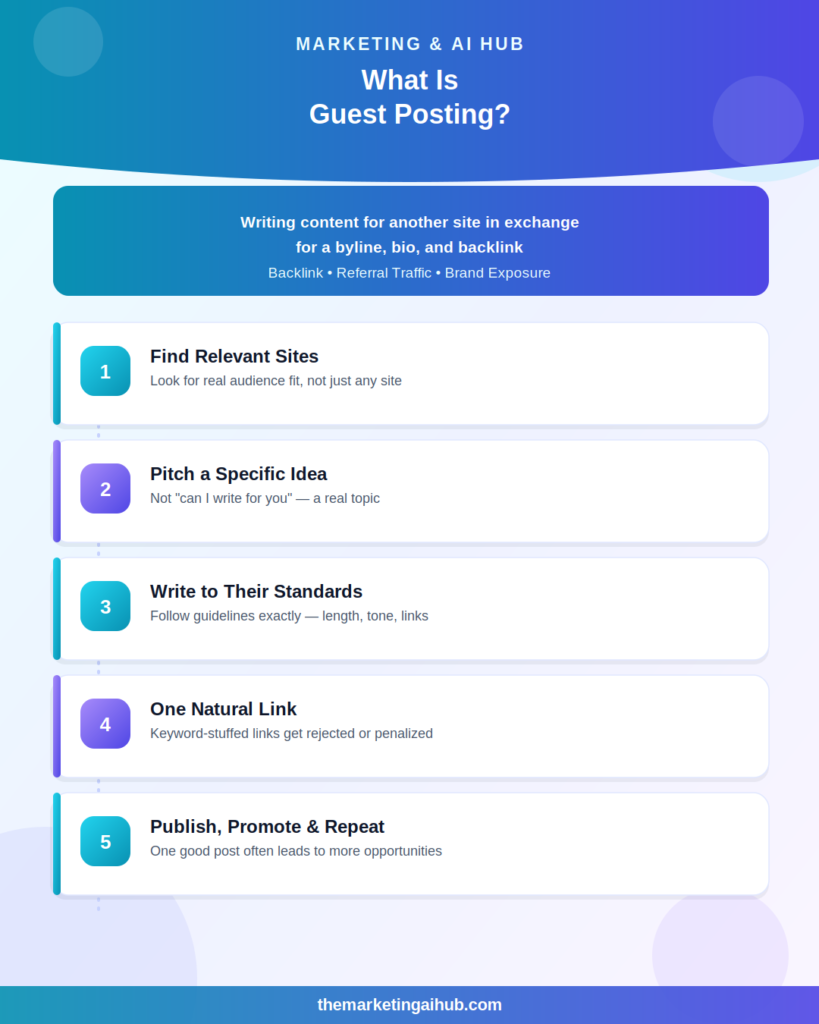
Guest posting (also called guest blogging) is the practice of writing and publishing an article on someone else’s website, usually in exchange for a byline, an author bio, and a link back to your own site or content. Instead of publishing every piece of content exclusively on your own blog, you contribute content to other websites in your niche — and in return, you get exposure to a new audience plus a backlink that can help your own site’s SEO.
At its core, guest posting is a trade: you provide free, valuable content to a website that already has an audience, and that website gives you visibility and a link in return. When done well, it benefits both sides — the host site gets quality content without having to write it themselves, and you get exposure and a legitimate backlink.
How Does Guest Posting Actually Work?
The process generally follows the same basic steps, regardless of your niche:
1. Find relevant websites that accept guest posts. You’re looking for sites that cover topics related to yours and already have an engaged audience — not just any site that says yes.
2. Pitch a specific article idea. Rather than asking “can I write for you,” successful pitches propose a specific topic, often with a rough outline, tailored to what that site’s audience actually wants to read.
3. Write the article to their standards. Most sites have specific guidelines — word count, tone, formatting, how many links are allowed. Following these closely dramatically increases your odds of approval.
4. Include a natural, relevant link. The link back to your site should fit naturally into the content, ideally pointing to a specific page that supports what you wrote — not just your homepage.
5. Publish and promote. Once it’s live, share it from your own channels too. This shows the host site you’re a genuine collaborator, not just there to grab a link and disappear.
Why Guest Posting Still Matters in 2026
Guest posting earns you three things at once, which is why it remains a core SEO tactic even as search evolves:
- A backlink — still one of the strongest trust signals search engines use to evaluate your site
- Referral traffic — real readers on the host site clicking through to see more of your work
- Brand exposure — appearing on a respected site in your niche builds credibility with an audience that didn’t know you before
There’s also a newer reason guest posting matters: it helps build the kind of external brand presence that shapes whether AI models like ChatGPT and Gemini recognize your business as a credible source. Getting mentioned and linked to on other relevant sites strengthens your brand’s footprint across the web — which increasingly affects AI-generated answers, not just traditional search rankings.
The Version That Gets Penalized
Guest posting has a bad reputation in some corners of SEO because of how often it’s abused. The version that causes real harm:
- Mass-pitching generic, low-quality articles to any site that will publish them
- Stuffing multiple keyword-optimized links into the article body instead of one natural link
- Paying for guest post placements purely for links, with no real editorial value
- Publishing the same or near-identical article across many different sites
Search engines have gotten better at recognizing these patterns, and sites built primarily around this kind of guest post spam have been directly targeted by recent quality updates. This is exactly why “done properly” matters more than “done often.”
How to Do Guest Posting the Right Way
Target sites your actual audience already reads. Relevance matters more than the size of the site — a smaller, tightly relevant site is often more valuable than a large, unrelated one.
Write something genuinely useful, not just link bait. The article should be good enough that it would stand on its own, even without the link back to you.
Follow each site’s specific guidelines exactly. Skipping this is the fastest way to get rejected before anyone even reads your pitch.
Keep your link count natural. One relevant, well-placed link is far more valuable — and far safer — than several.
Build relationships, not one-off transactions. Editors and site owners remember contributors who deliver quality work on time and promote what they write. A good first guest post often leads to more opportunities down the line.
How to Get Started
- Make a list of 10-15 websites in your niche that publish guest content (check their blog for an “author bio” or search “[your niche] + write for us”)
- Pick your top 3 and read several of their existing articles to understand their tone and audience
- Pitch one specific, well-thought-out article idea to each — not a generic request
- Write your strongest possible piece for whichever site says yes first
- Once published, promote it from your own channels and thank the editor — this is what turns a one-time post into an ongoing relationship
The Bottom Line
Guest posting isn’t a shortcut or a trick — it’s a genuine content partnership that happens to come with an SEO benefit. Done with real effort and relevance, it remains one of the most reliable ways to build backlinks, reach a new audience, and establish credibility in your niche, even as SEO continues to change around it.
Want help identifying the right guest posting opportunities for your niche, or feedback on a pitch before you send it? Visit
themarketingaihub.com/contact