
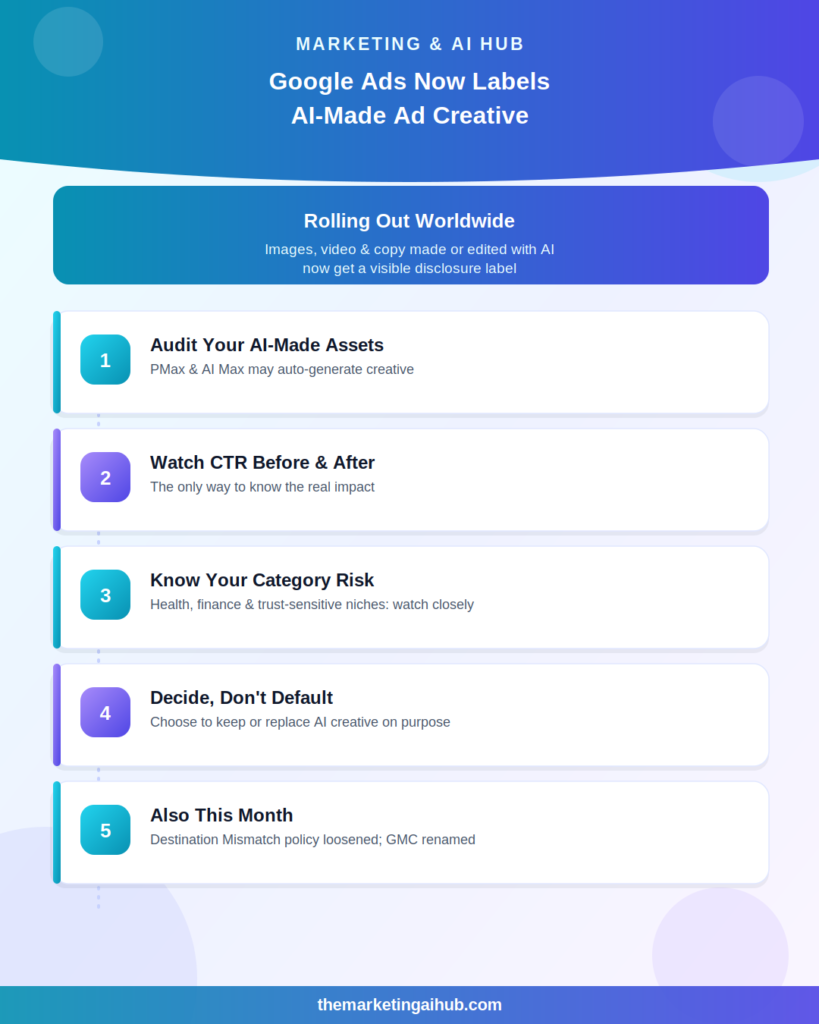
Google has started rolling out AI-made ad disclosures worldwide — a label that identifies when an ad’s creative (image, video, or copy) was generated or substantially edited using AI. If you’re running Performance Max, AI Max, or Demand Gen campaigns, some of your ads may already be eligible for this label without any action on your part. Here’s what’s actually changing, why it matters more than it might first seem, and what to do about it.
What’s Actually Rolling Out
Google is adding visible disclosures to ads whose creative assets were created or meaningfully edited with AI tools. This applies across formats — image, video, and in some cases copy — and is tied to the broader push toward AI-generated ad assets inside Performance Max, AI Max, and Demand Gen campaigns. The rollout is global, not limited to a single region, which signals Google is treating this as a permanent transparency standard rather than a regional test.
This builds directly on the Terms of Service changes from July 1, which already gave Google’s AI more contractual room to generate ad assets automatically from your website content. The disclosure requirement is the visibility layer that comes with that shift — advertisers get more automation, and in exchange, viewers get to know when they’re looking at AI-made creative.
Why This Matters More Than a Small UI Change
Consumer trust in AI-generated content is already fragile — research earlier this year found a majority of consumers worried about fake or AI-generated ads specifically. A visible “AI-made” label doesn’t just add a small disclosure line; it directly interacts with that existing wariness. For some audiences and categories, transparency will build trust. For others — particularly anything touching personal, financial, or health decisions — a visible AI label could measurably affect click-through and conversion behavior, in either direction, and that effect likely varies by industry and audience.
This is exactly the kind of change that’s easy to miss if you’re not actively checking your account, because it can apply to creative you didn’t manually flag as AI-made — anything generated through Performance Max or AI Max’s automated asset creation may already qualify.
What to Check in Your Account This Week
1. Audit which of your live assets are AI-generated. If you’re running Performance Max, AI Max, or Demand Gen with automated asset creation turned on, some of your current creative was very likely AI-generated without a manual review step. Go through your active assets and identify which ones this applies to.
2. Watch performance before and after the label appears. If you can identify when disclosure starts showing on your specific ads, compare click-through rate and conversion rate in the weeks immediately before and after. This is the only way to know whether the label is helping or hurting for your specific audience — assuming it won’t matter is a guess, not a strategy.
3. Consider your industry’s sensitivity level. Categories where trust is already fragile — health, finance, anything making a specific claim — are the ones most likely to see a real behavior shift from this disclosure. If you’re in one of these categories, this is worth monitoring closely rather than treating as a minor formatting update.
4. Decide deliberately, not by default, whether to keep AI-generated creative live. You’re not required to replace AI-made assets, but now is a reasonable moment to review whether the creative Google generated on your behalf actually represents your brand the way you’d want, now that it’s being labeled as AI-made publicly.
A Few Other July Updates Worth Knowing
Destination Mismatch policy loosened. Google is updating its Destination Mismatch policy to allow some Final URLs to redirect to a different domain — previously a stricter policy violation in many cases. Worth checking if this affects any campaigns where you’ve had URL-related disapprovals in the past.
Google Merchant Center Next is now just “Google Merchant Center.” A naming simplification, but if you have saved documentation, help articles, or internal guides referencing “Merchant Center Next,” it’s worth a quick update so nothing reads as outdated to a client.
The Bottom Line
Ad transparency requirements are only going to expand as more ad creative becomes AI-generated by default rather than by manual choice. The advertisers who come out ahead here aren’t the ones avoiding AI tools — they’re the ones actively monitoring what’s live, checking real performance data instead of assuming disclosure is neutral, and making a deliberate call on creative quality rather than letting automation run unreviewed.
Want a second set of eyes on which of your ad assets are AI-generated, or help monitoring performance around this rollout?
Visit themarketingaihub.com/contact