
If you’re only using one AI assistant, there’s a good chance you’re leaving real productivity on the table. ChatGPT (from OpenAI) and Claude (from Anthropic) have both become genuinely excellent by 2026 — but “which one is smarter” is the wrong question at this point. Both are strong enough that the real question is which one is actually better suited to what you’re trying to do. Here’s a practical, honest breakdown.
The Short Version
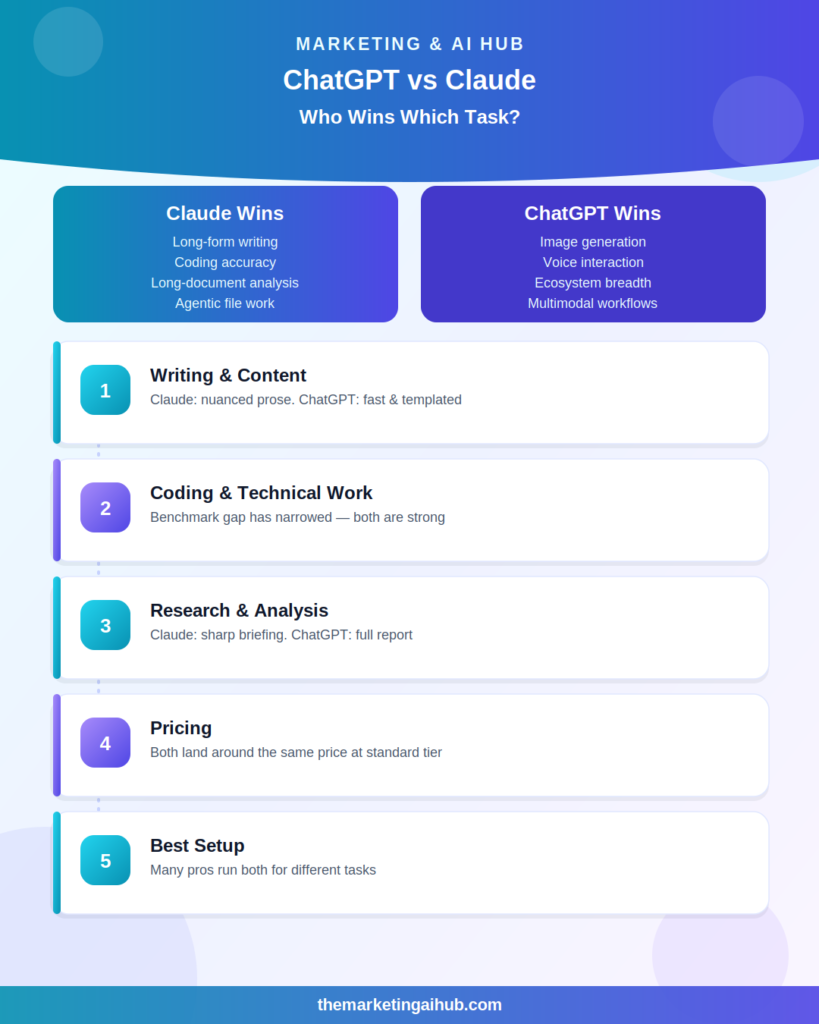
Claude tends to lead on long-form writing, nuanced tone, coding accuracy, long-document analysis, and agentic work (letting the AI carry out multi-step tasks on your behalf). ChatGPT tends to lead on image generation, voice interaction, and overall ecosystem breadth — it’s built to be a broader, more multimodal tool. Pricing is no longer much of a differentiator either way; both offer a free tier and land around the same price point for their standard paid plan.
Writing and Content Creation
This is where Claude has built its strongest reputation. Its prose tends to read more naturally, follows detailed style instructions more precisely, and avoids some of the hedging, over-qualifying tone that can show up in AI-generated writing. For long-form content — blog posts, reports, nuanced editing — many writers and content teams reach for Claude first.
ChatGPT is very capable for shorter, structured, template-driven content, and its Canvas feature (a side-by-side writing and editing workspace) is genuinely useful for iterating on a draft. If your work leans toward quick-turnaround copy or highly templated content, ChatGPT holds up well.
Coding and Technical Work
Both platforms are strong coding assistants, and the gap on published coding benchmarks has narrowed considerably over the past year — for many production tasks, the difference won’t be the deciding factor. Where Claude tends to stand out is longer codebases and large context windows, which matter when you’re debugging or refactoring something that spans multiple files, and in how clearly it explains its own reasoning while working through a problem.
Images, Voice, and Multimodal Work
This is ChatGPT’s clearest advantage. If your workflow depends on generating images, using voice interaction, or working across a broader multimodal toolkit inside one app, ChatGPT is currently the more complete option. Claude’s strengths sit more in text-based and document-based work rather than visual generation.
Research and Analysis
The difference here is more about style than raw capability. Claude tends to synthesize a pile of information into a clear point of view — closer to a sharp briefing that tells you what actually matters. ChatGPT tends to lay information out in a more thorough, scannable structure, especially when using its deep research features to do the initial legwork for you. Neither approach is objectively better; it depends on whether you want a distilled take or a comprehensive report.
Agentic Tools (Letting AI Do Multi-Step Work)
Both companies have invested heavily in letting their AI actually carry out tasks, not just answer questions — coding agents, browser automation, and file-based work. This is one of the fastest-moving parts of the comparison, and both platforms now offer some form of agentic tooling even at their standard paid tier, which was a meaningful gap as recently as last year.
What Actual Users Say
Across the major online communities where people discuss both tools regularly, a few consistent themes show up. Claude tends to get credit for a more direct, less reflexively agreeable tone — it’s more willing to push back rather than default to telling you you’re right. The most common complaint about Claude is usage limits at the standard tier, which is frequently cited as the reason people end up supplementing it with another tool. ChatGPT’s most common complaint is the lack of a mid-tier plan between its free and premium pricing.
How to Actually Choose
Pick Claude if: your priority is coding accuracy, long-document analysis, nuanced long-form writing, or agentic file work.
Pick ChatGPT if: you need image generation, voice interaction, or a broader multimodal ecosystem in one place.
Consider running both if: AI is a core part of your daily workflow. A common professional setup in 2026 is ChatGPT for ideation, quick questions, and visuals, paired with Claude for serious writing, editing, and document-heavy work. At roughly similar pricing for each, running both is a modest cost against the time saved if you’re using AI daily.
The Bottom Line
Neither tool is universally “better” in 2026 — they’ve genuinely diverged into different strengths rather than converging into one obvious winner. The most useful thing you can do is match the tool to the task in front of you, rather than picking one AI assistant and forcing every kind of work through it.
Curious which AI tools actually fit your specific workflow as a freelancer or small business? Visit
themarketingaihub.com/contact