
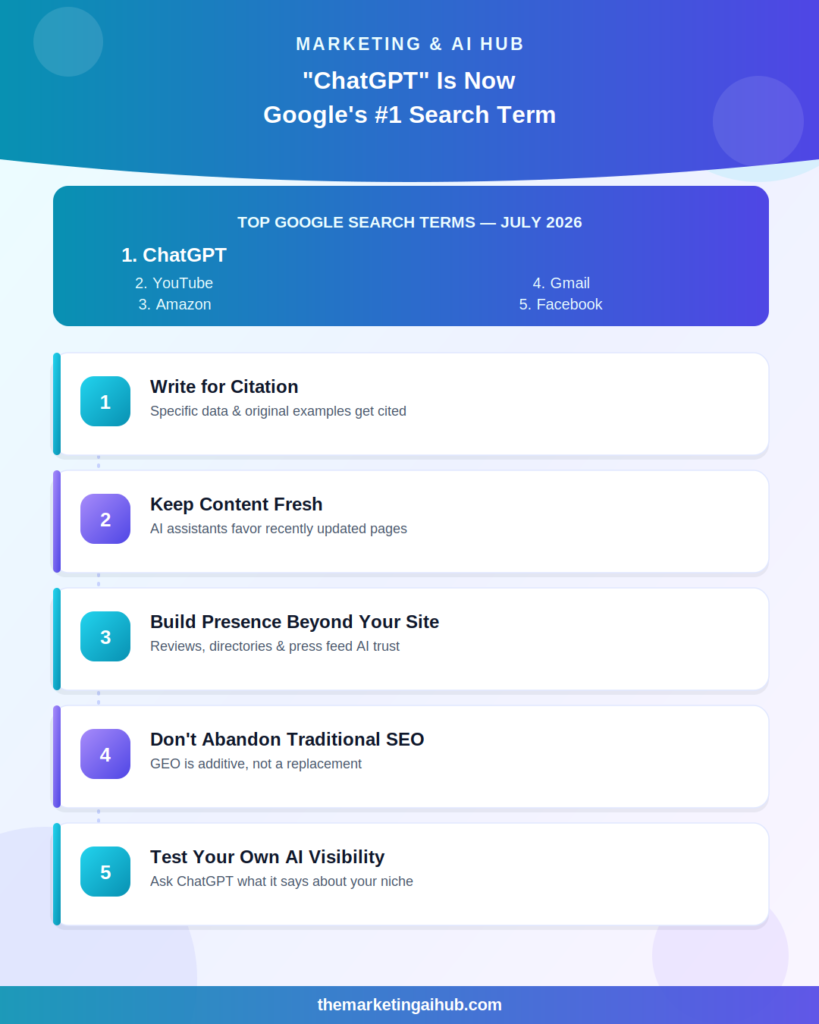
Here’s a stat worth sitting with: as of July 2026, “ChatGPT” is the single most-searched term on Google — ahead of YouTube, Amazon, Gmail, and Facebook. People are literally Googling their way into an AI assistant before doing anything else. That’s not a niche AI-industry data point; it’s a signal about where search behavior as a whole is heading, and it has direct implications for how marketers should be thinking about visibility in 2026.
Why This Is a Bigger Deal Than It Looks
Search terms like “YouTube,” “Amazon,” and “Gmail” have topped these lists for years because they’re navigational — people use Google as a launchpad to get to a platform they already use daily. “ChatGPT” now sitting above all of them means AI assistants have crossed into that same category of daily-habit software, at a scale that’s reshaping the front door of the internet.
This matters for marketers because it confirms something that’s been building for over a year: a meaningful and growing share of your audience’s information journey no longer starts and ends on a traditional search results page. It increasingly detours through — or starts directly inside — a conversational AI platform.
The Behavior Shift Behind the Number
Research tracking AI Overviews and AI Mode usage has identified a common pattern in how people now interact with search: Search → Verify Summary → Click Citation. Instead of scanning a list of blue links, users read an AI-generated summary first, and only click through to a source when they want to verify or dig deeper. Being the cited source in that summary — not just ranking highly in traditional results — has become the goal worth optimizing for.
This is part of why the discipline now called Generative Engine Optimization (GEO) has emerged alongside traditional SEO. GEO focuses less on keyword density and backlinks, and more on “information gain” — giving AI models a genuinely unique data point, statistic, or perspective they can’t get from ten other nearly-identical articles. Generic, rehashed content has little chance of getting cited; content with a specific, distinct piece of value has a real shot.
What Marketers Should Actually Do About It
1. Write for citation, not just ranking. Include specific data points, original examples, or clearly stated conclusions that an AI model could lift directly into a summary and attribute to you. Vague, generic advice gets paraphrased and stripped of attribution; specific claims tend to get cited.
2. Keep content fresh. Recent analysis of AI citation patterns found that AI assistants consistently favor more recently updated content when choosing what to cite. A once-published, never-updated post has a shrinking shelf life in this environment — revisiting and updating older posts is now part of the job, not optional maintenance.
3. Build real brand presence outside your own website. If people are increasingly asking ChatGPT or AI Mode about your industry, category, or even your business by name, you want your brand mentioned in more places across the web than just your own site — review platforms, directories, social profiles, and press mentions all feed into how confidently an AI model recognizes and recommends you.
4. Don’t abandon traditional SEO. Google Search itself remains the top single traffic source for most sites, and classic ranking factors still matter for the searches that do result in clicks. GEO is additive, not a replacement — the sites doing well right now are treating it as a second discipline running alongside SEO, not a swap.
5. Watch your own niche’s AI visibility, not just Google’s. Try asking ChatGPT or Perplexity questions a potential client might ask about your industry, and see whether you — or your competitors — show up in the answer. That’s a fast, free way to gauge where you actually stand in this new search layer.
The Takeaway
“ChatGPT” outranking “YouTube” and “Amazon” as a Google search term isn’t a quirky headline — it’s a clear marker that AI platforms have become a default habit for a large share of internet users, not an experimental add-on. Marketers who start optimizing for both citation and clicks now will have a real head start over those still treating this as a future problem.
Want to know how visible your brand actually is inside AI answers, or need a content strategy built for both Google and
GEO? Visit themarketingaihub.com/contact