
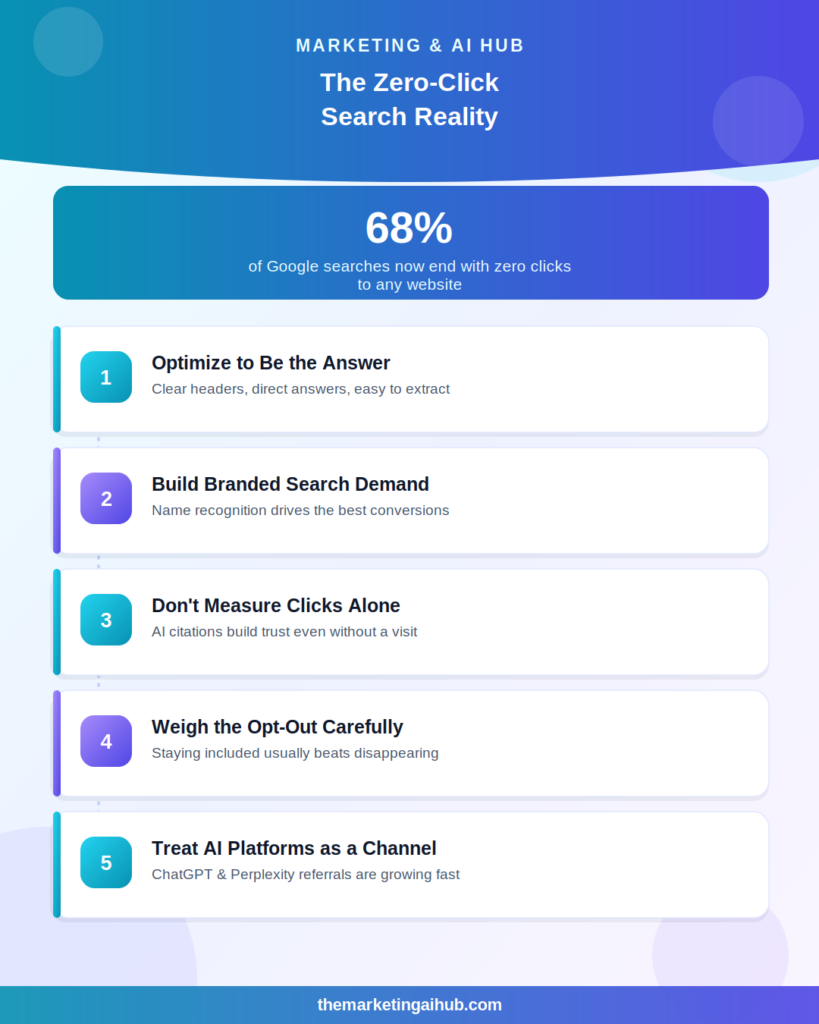
If you’re publishing content and wondering why traffic feels harder to earn than it used to, here’s the number that explains a lot of it: roughly 68% of Google searches in the US now end without a click to any website. People are getting their answer directly on the results page — mostly through AI Overviews — and never making it to the source. This changes what “good SEO” actually means in 2026, and it’s worth rethinking your strategy around it rather than fighting it.
What’s Actually Happening
AI Overviews synthesize an answer from multiple sources and display it directly on the search results page. The summary does include source links, but a large share of users read the answer and stop there — they never click through, even when a link is sitting right in front of them. For publishers and content sites, this has meant measurable drops in traffic even when rankings stay strong, because ranking well no longer guarantees a visit.
This pressure has gotten enough attention that UK regulators recently required Google to give publishers more leverage in how their content is used inside these AI summaries — and shortly after, Google began testing a tool that lets site owners opt their pages out of AI-generated summaries entirely, while keeping their normal search rankings intact. That tool is expected to roll out more broadly, not just in the UK.
The Flip Side: AI-Referred Traffic Converts Better
Here’s the part that matters for anyone still getting traffic from AI platforms: when someone does click through from an AI answer — whether that’s Google’s AI Mode, ChatGPT, or Perplexity — they tend to be a much higher-quality visitor. Recent analysis found that shoppers arriving via AI sources convert at meaningfully higher rates than average web visitors, and spend significantly more time on-site.
The explanation is fairly intuitive: someone who asks an AI assistant a specific question, gets a direct recommendation, and then clicks through is arriving with their intent already refined. They’re not casually browsing — they came for something specific and chose to keep going. Fewer visitors, but visitors who are more likely to actually convert.
What This Means for Your Content Strategy
1. Optimize to be the answer, not just a result. AI Overviews and AI Mode pull from content that answers a question clearly and directly. Structure your posts so the core answer is easy to extract — clear headers, direct answers early in a section, and well-organized information — rather than burying the answer three paragraphs into a story.
2. Build for branded search, not just generic keywords. As AI answer surfaces absorb more generic informational searches, branded searches — people searching for your business by name — remain unaffected and produce the most efficient conversions. This makes brand recognition, not just keyword ranking, a real SEO priority. If your Facebook and YouTube presence gets people to remember your name, that’s now doing real SEO work indirectly.
3. Don’t measure success by clicks alone. If your content is getting cited inside AI Overviews or AI Mode answers, that’s brand visibility and trust-building even without a click. It’s harder to measure than a pageview, but it’s not worthless — it’s simply a different kind of value than traditional SEO traffic.
4. Watch for the opt-out decision, but don’t rush it. If Google’s AI summary opt-out tool rolls out to your region, opting out won’t hurt your normal search rankings — but it also means giving up any visibility inside AI Overviews entirely. For most small businesses and freelancers, staying included is still the better move, since branded visibility inside an AI answer is still visibility.
5. Treat AI platforms as an emerging referral channel, not a threat to ignore. ChatGPT and Perplexity referral traffic is growing quickly as these platforms add more prominent links in their answers. Structuring content the same way — clear, well-organized, directly answering real questions — helps you show up across all of these surfaces, not just classic Google search.
The Realistic Takeaway
Zero-click search isn’t a temporary glitch — it’s the direction search is heading, and fighting it by chasing raw pageviews is a losing strategy. The better move is adapting to what’s actually converting now: fewer, higher-intent visitors from AI platforms, and stronger returns from people who already know your name because they’ve seen you elsewhere. Classic SEO isn’t dead, but it’s no longer the whole game.
Want help auditing whether your content is structured to get picked up by AI Overviews, or building a brand-recognition
strategy that works alongside SEO? Visit themarketingaihub.com/contact