
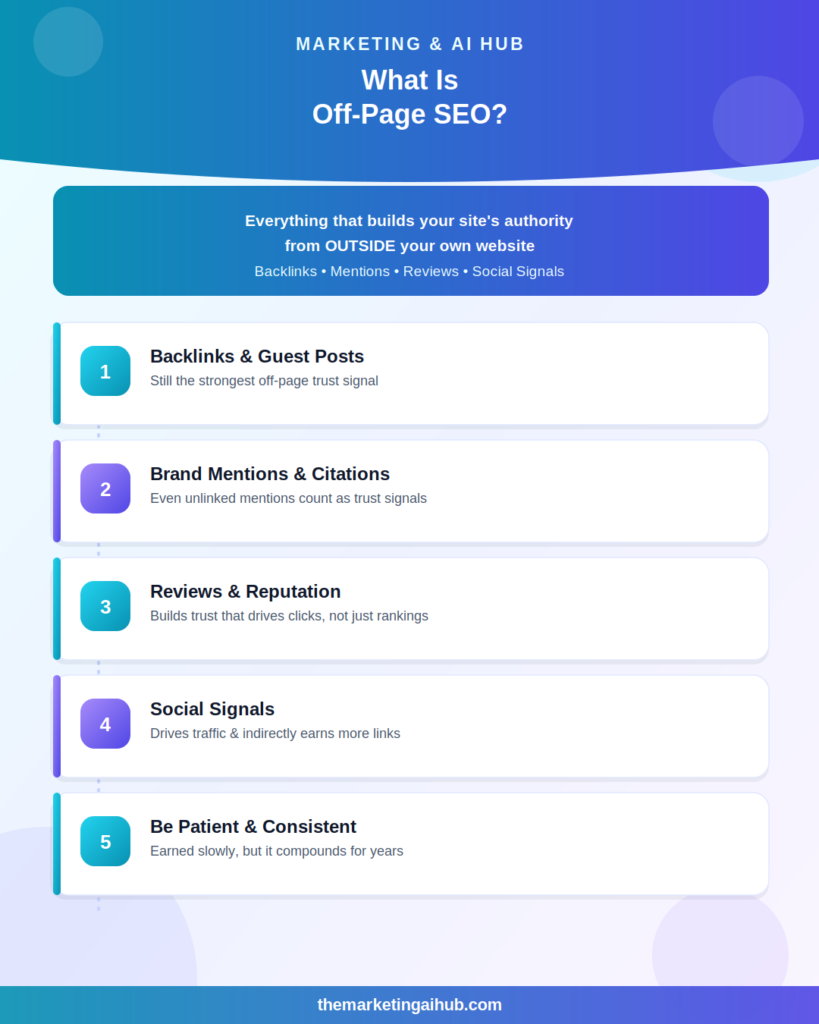
Most beginners focus entirely on what’s written on their own website — keywords, headers, page speed. That’s on-page SEO, and it matters, but it’s only half the picture. The other half happens away from your site entirely, on other people’s websites, social platforms, and across the web at large. That’s off-page SEO, and it’s often the difference between a well-optimized site that never ranks and one that actually breaks through. This guide covers what off-page SEO actually is, what it includes, and how to start building it.
What Is Off-Page SEO?
Off-page SEO refers to all the actions taken outside of your own website that influence your search engine rankings. Where on-page SEO is about optimizing your content, structure, and code, off-page SEO is about building your site’s authority, trustworthiness, and reputation through signals that come from elsewhere — other websites linking to you, people mentioning your brand, and your presence across the wider web.
The core idea behind off-page SEO is simple: search engines can’t just trust what a website says about itself. If your homepage claims to be the best plumbing service in your city, that means nothing on its own — but if a dozen other reputable local sites and directories link to you and reference your business, that’s an independent signal search engines can actually trust.
Off-Page SEO vs. On-Page SEO
It helps to think of it as the difference between what you control directly and what you earn from others:
- On-page SEO — your content, headers, meta descriptions, internal linking, page speed, keyword targeting. You have full control.
- Off-page SEO — backlinks, brand mentions, social signals, reviews, and reputation. You influence it, but you don’t fully control it — it’s earned, not set.
Both matter, and neither fully substitutes for the other. A site with perfect on-page SEO but zero off-page authority will struggle to rank for anything competitive. A site with strong off-page signals but weak on-page content won’t convert the traffic it does earn.
The Main Components of Off-Page SEO
Backlinks. Still the most influential off-page factor. When other websites link to yours, it signals trust and relevance — especially when the linking site is itself reputable and topically related to yours.
Guest posting. Writing content for other relevant sites in exchange for a link and exposure — a direct way to earn both a backlink and referral traffic at the same time.
Brand mentions. Even when a site references your business without a clickable link, search engines increasingly recognize these unlinked mentions as a trust signal, especially when they appear consistently across credible sources.
Local citations. Consistent listings of your business name, address, and phone number across directories like Google Business Profile, Bing Places, and industry-specific directories. This matters enormously for local SEO specifically.
Social signals. While likes and shares aren’t a direct ranking factor the way backlinks are, an active social presence drives real traffic, increases brand visibility, and often leads indirectly to more backlinks and mentions as your content gets discovered and shared.
Reviews and reputation. Genuine reviews on Google, industry-specific platforms, and third-party review sites build trust signals that influence both rankings and, just as importantly, whether people actually click through and convert once they find you.
Influencer and community engagement. Getting genuinely mentioned or discussed in relevant online communities, forums, and by people with real audiences in your niche builds the kind of organic visibility that’s difficult to fake and valuable when it happens naturally.
Why Off-Page SEO Matters More Than Ever
Off-page SEO isn’t just about traditional search rankings anymore. The same signals that build trust with Google — backlinks, mentions, reviews, consistent presence across the web — are increasingly what shapes whether AI models like ChatGPT and Gemini recognize your business as a credible source worth citing. A business that’s only ever discussed on its own website has a much thinner footprint for an AI model to draw confidence from than one that’s mentioned, linked, and reviewed across multiple independent sources.
How to Start Building Off-Page SEO
1. Claim your free listings first. Google Business Profile, Bing Places, and relevant directories in your niche — this is the fastest, lowest-effort starting point.
2. Reclaim unlinked brand mentions. Search your business name and ask sites that already mention you to add a link.
3. Pursue a few genuine guest posting opportunities. One well-placed guest post on a relevant site is worth more than a dozen low-quality ones.
4. Ask satisfied clients for reviews. A handful of genuine reviews on Google and relevant platforms builds real trust signals over time.
5. Share your content actively, don’t just publish it. Off-page SEO benefits compound when your content actually gets seen and shared, not just posted.
6. Be patient and consistent. Off-page authority builds gradually — a handful of genuine signals earned over months is far more valuable, and far safer, than a rush of low-quality links or mentions gathered all at once.
The Bottom Line
Off-page SEO is what turns a well-built website into a trusted one. It can’t be faked convincingly, and it can’t be built overnight — but it’s also one of the most durable forms of SEO progress, because backlinks, reviews, and mentions earned honestly keep working for you long after you’ve stopped actively pursuing them. If your on-page SEO is solid but your rankings still aren’t moving, off-page is almost always the missing half.
Want help building a realistic off-page SEO plan for your specific site and niche? Visit themarketingaihub.com/contact