
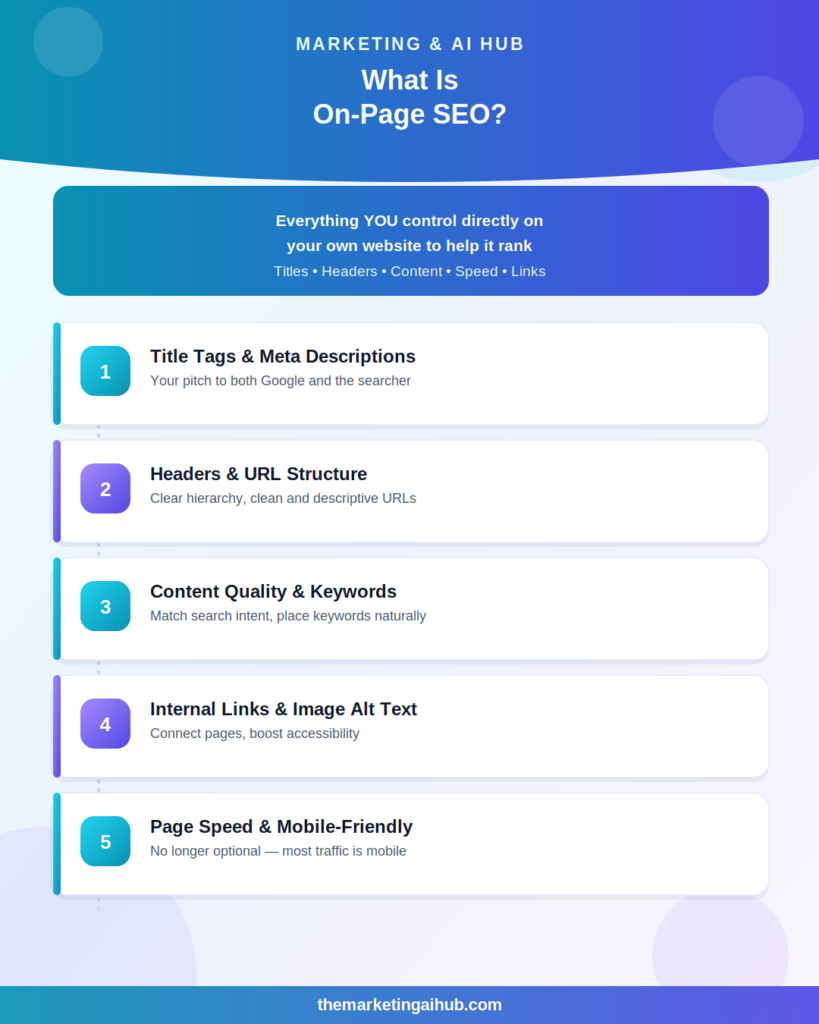
If off-page SEO is about building trust from outside your website, on-page SEO is everything you can control directly on your own site to help both search engines and real visitors understand and rank your content. It’s the foundation every other SEO effort builds on — get this wrong, and even strong backlinks and great off-page work won’t fully pay off. This guide covers exactly what on-page SEO includes and how to actually do it well.
What Is On-Page SEO?
On-page SEO refers to all the optimizations made directly on your website’s pages to improve their search engine rankings and relevance — things like your content itself, your titles and headers, your page structure, your images, and your internal links. Unlike off-page SEO, which depends on other websites and external signals, on-page SEO is entirely within your control, which makes it the natural starting point for anyone new to SEO.
The goal of on-page SEO is twofold: help search engines clearly understand what a page is about and how relevant it is to a given search, and give real visitors a page that’s genuinely useful, readable, and easy to navigate once they arrive.
The Core Elements of On-Page SEO
Title tags. The clickable headline shown in search results. It should include your target keyword naturally, stay under roughly 60 characters so it doesn’t get cut off, and clearly describe what the page actually offers.
Meta descriptions. The short summary shown below the title in search results. While not a direct ranking factor, a compelling meta description directly affects whether people actually click through — treat it as your pitch to the searcher.
Headers (H1, H2, H3). Your H1 should clearly state the page’s main topic, and H2s/H3s should break the content into logical, scannable sections. This helps both readers skim your content and helps search engines understand your page’s structure and hierarchy.
URL structure. Clean, short, descriptive URLs that include your target keyword perform better than long, cluttered ones full of numbers or irrelevant parameters. A URL like /what-is-on-page-seo/ is far more useful than /page?id=4821.
Content quality and relevance. This is the heart of on-page SEO. Content needs to genuinely answer the search intent behind the keyword it targets — thoroughly, clearly, and without unnecessary padding. Thin, generic content consistently underperforms well-developed, specific content, even when both target the same keyword.
Keyword placement. Your primary keyword should appear naturally in the title, the first paragraph, at least one header, and a few times throughout the body — but never forced or repeated unnaturally. Modern search engines read for meaning and context, not just keyword frequency.
Internal linking. Linking to other relevant pages on your own site helps visitors find more of your content, helps search engines discover and understand the relationship between your pages, and spreads authority across your site rather than concentrating it all on one page.
Image optimization. Descriptive file names and alt text help search engines understand what an image shows, improve accessibility for visually impaired visitors, and can occasionally earn traffic through image search. Compressed, appropriately-sized images also directly affect page speed.
Page speed and mobile-friendliness. A slow-loading or poorly-formatted-on-mobile page hurts rankings directly and drives visitors away before they even read your content. With most search traffic now happening on mobile devices, this is no longer optional.
On-Page SEO vs. Off-Page SEO
Think of on-page SEO as everything you build, and off-page SEO as everything you earn. On-page SEO tells search engines and visitors exactly what a page is and why it deserves to rank; off-page SEO tells them the rest of the internet actually trusts and values that page too. Neither one fully compensates for a weak version of the other — a well-optimized page on an untrusted site struggles to rank, and a trusted site with poorly optimized pages leaves ranking potential on the table.
Why On-Page SEO Matters Even More With AI Search
The core principles of good on-page SEO — clear structure, direct answers, well-organized headers — are exactly what AI Overviews and AI chat assistants look for when deciding what to extract and cite in a generated answer. A page that’s genuinely well-structured for a human reader tends to also be easier for an AI model to parse and quote accurately. On-page SEO isn’t just a Google ranking exercise anymore; it’s also what makes your content usable as a source across every AI search surface.
Common On-Page SEO Mistakes
- Keyword stuffing — repeating a keyword unnaturally instead of writing for readability first
- Duplicate or thin content — pages that don’t offer enough unique value to justify ranking on their own
- Ignoring mobile experience — testing only on desktop while most visitors arrive on a phone
- Missing or generic meta descriptions — leaving search engines to auto-generate a snippet instead of controlling your own pitch
- Weak internal linking — publishing content that exists in isolation instead of connecting it to the rest of your site
How to Get Started
- Pick one existing page and run through this checklist — title tag, meta description, headers, URL, keyword placement, internal links, image alt text
- Fix the gaps you find, prioritizing whichever page already gets the most traffic or has the clearest ranking potential
- Apply the same checklist to every new piece of content before it goes live, rather than fixing it after the fact
- Recheck page speed and mobile rendering periodically, since both can quietly degrade as a site grows
The Bottom Line
On-page SEO is the part of SEO you have full control over, which makes it the highest-leverage place to start — especially for a newer site still building off-page authority. Done well, it doesn’t just help you rank; it makes your content genuinely easier to read, navigate, and trust, for human visitors and AI models alike.
Want a full on-page SEO audit of your existing website? Visit themarketingaihub.com/contact